


A window
陈思颖
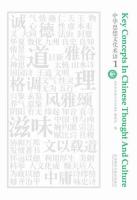
A Window into Chinese Wisdom: A Review of Key Concepts in Chinese
Thought and Culture For English majors who aspire to be bridges
between Eastern and Western cultures, Key Concepts in Chinese Thought
and Culture is more than a reference book—it is a profound and
accessible guide to the essence of Chinese civilization. This
meticulously compiled volume, which selects and interprets core terms
spanning philosophy, ethics, politics, and art, offers a rare
opportunity to grasp the nuances of Chinese thought without the barrier
of cultural misunderstanding. What sets this book apart is its
rigorous yet reader-friendly approach. Unlike superficial translations
that often reduce Chinese concepts to vague equivalents, each entry in
the book provides a comprehensive explanation: the term’s etymological
roots, its evolution across dynasties, and its practical implications in
traditional and modern contexts. For example, the term “He” (harmony) is
not merely translated as “peace” or “unity”; the book elaborates on its
connotation of “harmony in diversity”—a concept that has shaped China’s
attitude toward coexistence since ancient times, from the harmonious
cohabitation of different ethnic groups in feudal society to the modern
diplomatic principle of seeking common ground while shelving
differences. Similarly, “Ren” (benevolence), the cornerstone of
Confucianism, is unpacked through its original meaning of “loving
others,” paired with examples from the Analects to illustrate how this
virtue guided personal conduct and governance in traditional China, such
as Confucius’ advocacy of treating the people with benevolence and
rulers’ emphasis on moral education over harsh punishment. Another
highlight of the book is its commitment to cross-cultural communication.
For English learners and educators, the precise translations and
contextual notes are invaluable. It addresses a common pain point: many
Chinese philosophical terms lack direct counterparts in English, leading
to misinterpretation. For instance, “Dao” is often inaccurately rendered
as “the Way,” but the book clarifies that it encompasses both the
natural law of the universe and the path of moral cultivation, drawing
parallels between the Daoist pursuit of aligning with nature and the
Western philosophical exploration of the fundamental rules of the world.
Such detailed explanations help readers avoid the trap of literal
translation and instead understand the cultural spirit behind each term,
equipping them to engage in meaningful cross-cultural dialogues.
Beyond its academic value, the book serves a timely purpose in today’s
globalized world. As exchanges between China and other countries deepen
in fields like economy, education, and art, there is an urgent need for
a shared understanding of Chinese thought. This book acts as a mediator,
breaking down stereotypes and showing that Chinese culture is not a
static relic but a dynamic system of ideas that continues to influence
modern society. For example, the concept of “Zhong Yong” (the golden
mean) is still widely applied in modern management, advocating for
balanced decision-making rather than extreme measures. For English
education students like me, it is an essential resource for designing
courses that foster cross-cultural literacy, enabling future learners to
appreciate the richness of Chinese thought while thinking critically
about cultural differences. Of course, the book has its limitations.
Given the vastness of Chinese thought, some niche terms from regional
cultures or folk traditions are not included, such as the unique ethical
concepts of some ethnic minorities in southwest China, which leaves room
for expansion in future editions. Moreover, the book could benefit from
more comparative analyses with Western philosophical terms, which would
further enhance its value for cross-cultural studies. However, these
minor flaws do not diminish the book’s core value. In conclusion, Key
Concepts in Chinese Thought and Culture is a masterpiece that balances
scholarship and accessibility. It is a must-read for English majors,
language educators, and anyone who wishes to delve into the depth of
Chinese culture. More than a collection of terms, it is a window into
the Chinese way of thinking—a way that emphasizes harmony, virtue, and
the unity of humanity and nature. For those who strive to connect
cultures through language, this book is not just a tool; it is an
inspiration to build a more inclusive world through mutual understanding
and respect.

 京公网安备 11010802032529号