

Review
用户824299
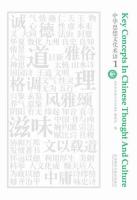
A Profound Window into Chinese Wisdom: A Review of Key Concepts in
Chinese Thought and Culture In the globalized landscape where cultural
exchanges are increasingly frequent, the need to decode the essence of
Chinese civilization has never been more pressing. Key Concepts in
Chinese Thought and Culture emerges as an extraordinary lexicon,
bridging the gap between Eastern philosophy and Western understanding
with meticulous scholarship and profound insight. Spanning over a
thousand years of intellectual heritage, this book is far more than a
mere glossary; it is a profound exploration of the ideas that have
shaped the soul of China, offering readers a rare opportunity to grasp
the subtle nuances and deep-rooted meanings of terms that are often
oversimplified or misinterpreted in cross-cultural communication. What
sets this book apart is its rigorous yet accessible approach to each
term. Unlike conventional dictionaries that provide only superficial
translations, every entry in this volume is a miniature essay, weaving
together historical context, philosophical evolution, and practical
application. Take “Dao” (the Way), for instance. The book does not stop
at equating it to a vague “path” or “principle”; instead, it traces its
origins from the Tao Te Ching to its diverse interpretations in
Confucianism, Taoism, and even modern Chinese thought. It elucidates how
“Dao” embodies both the cosmic order of the natural world and the moral
compass for human conduct, revealing the holistic worldview that
distinguishes Chinese philosophy from its Western counterparts.
Similarly, the explanation of “Ren” (benevolence) goes beyond a simple
definition of “kindness”, delving into its role as the core of Confucian
ethics—the virtue that binds individuals, families, and societies
together in a harmonious hierarchy of mutual responsibility. Another
highlight of the book is its attention to the dynamic nature of these
cultural terms. Chinese thought is not a static relic of the past; it is
a living tradition that continues to evolve and adapt to contemporary
times, and this book captures that vitality brilliantly. For example,
the entry on “He” (harmony) explores its ancient roots in the I Ching
(Book of Changes), where it denotes the balance of opposing forces, and
then connects it to modern concepts such as “harmonious society”,
demonstrating how this age-old idea remains relevant in addressing the
challenges of globalization and social cohesion. The book also does an
excellent job of clarifying the distinctions between terms that are
often conflated, such as “Li” (ritual propriety) and “Yi”
(righteousness), showing how they complement each other to form the
foundation of Confucian moral philosophy. Moreover, the book’s
editorial team deserves high praise for its commitment to accuracy and
neutrality. Avoiding the pitfalls of cultural chauvinism or
Western-centric bias, it presents each concept with scholarly
objectivity, acknowledging both the richness of Chinese thought and the
debates and controversies that have surrounded these terms throughout
history. The translations are precise yet elegant, striking a delicate
balance between literal fidelity and idiomatic expression in English,
making the book accessible to both academic researchers and general
readers with an interest in Chinese culture. The inclusion of example
sentences and quotations from classical texts further enhances its
practical value, allowing readers to see how these terms are used in
their original contexts. If there is any minor flaw in this book, it
is that its scope, while comprehensive, may feel overwhelming to readers
who are new to Chinese philosophy. With hundreds of terms covered, from
metaphysical concepts like “Qi” (vital energy) to political ideas like
“Zhengdao” (the righteous path of governance), the sheer volume of
information can be daunting at first glance. However, this is a small
price to pay for the depth and breadth of knowledge that the book
offers. Readers can easily navigate the book by focusing on specific
areas of interest, whether it is Confucian ethics, Taoist cosmology, or
Buddhist-inspired terms that have integrated into Chinese thought over
time. In conclusion, Key Concepts in Chinese Thought and Culture is an
indispensable resource for anyone seeking to understand the intellectual
foundations of Chinese civilization. It is a book that rewards careful
reading, inviting readers to embark on a journey of discovery through
the intricate web of ideas that have shaped one of the world’s oldest
and most vibrant cultures. In an era where cross-cultural understanding
is more important than ever, this book serves as a vital bridge,
fostering mutual respect and appreciation between East and West. Whether
you are a student of philosophy, a scholar of Asian studies, a
translator, or simply a curious reader, this book will deepen your
understanding of Chinese thought and enrich your perspective on the
diversity of human wisdom. It is not just a reference book to be
consulted; it is a treasure trove of insight to be savored and revisited
time and again.

 京公网安备 11010802032529号